Episode 19: Contract Embroidery Exposed — with Joe Perez
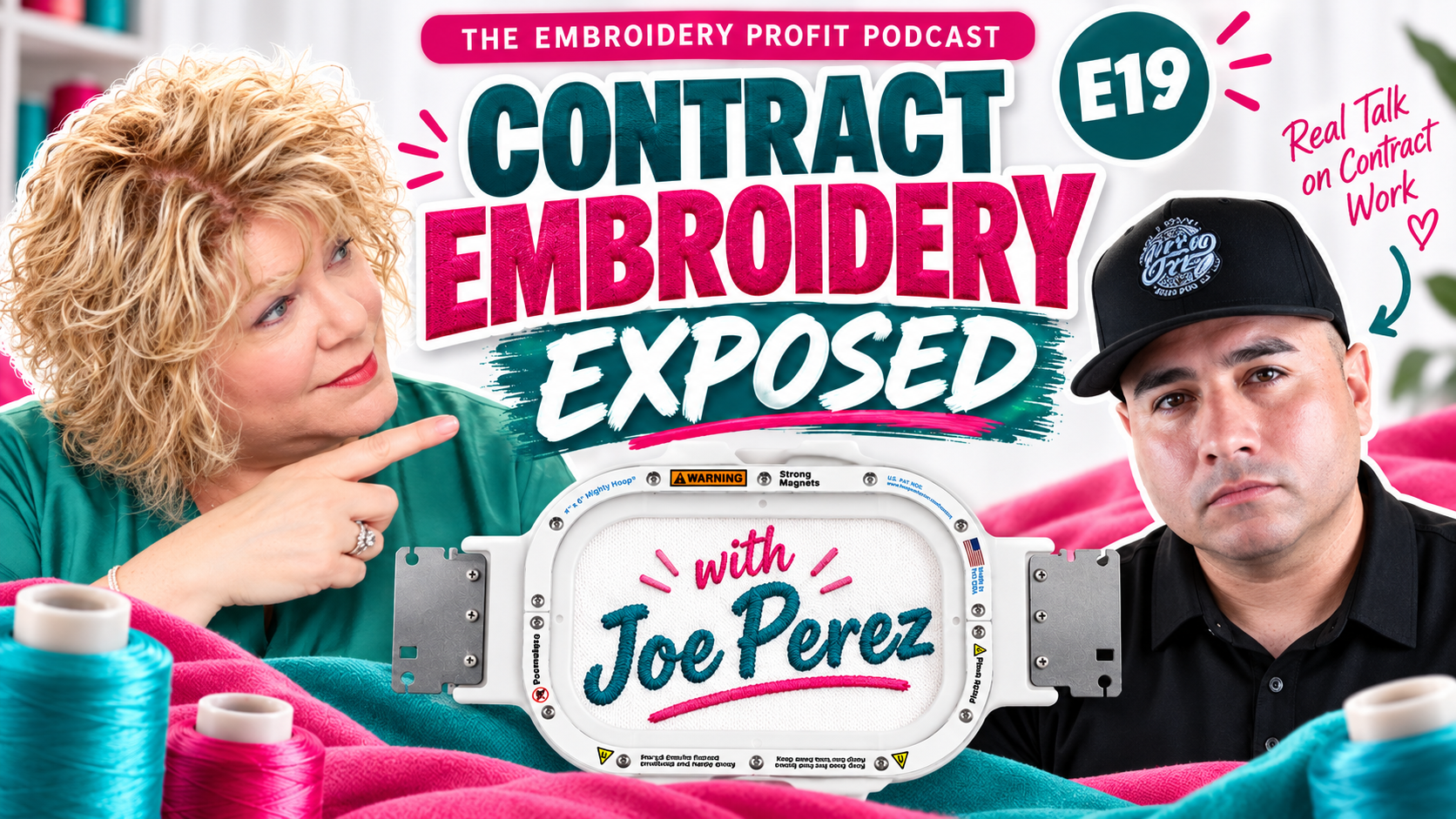
Scaling Your Shop: The Realities of Contract Embroidery with Joe Perez
From Home Shop to Storefront Success
Hi everyone. My name's Hope Yoder and welcome to the Embroidery Profit Podcast. I'm here with my friend Joe Perez. We're on location, so we don't have that beautiful studio. So please forgive us. You know, he didn't even comb his hair, you guys. Look I thought—
So, I we just gather a few of my friends in the industry that their business model is a little different than mine. So this is Joe Perez of Heart and Hustle. How can they find you on Instagram or YouTube?
So you can find me at Heart and Hustle Printing, on Instagram or YouTube.
Right, so tell me about well tell everybody where's your shop and what do you do?
So I'm located in Evans, Georgia, which is like five miles away from Augusta, Georgia, where the Masters is at. So everybody knows where that's at. So that's where we're located. And then my shop is a one stop shop where we do everything from screen printing, embroidery, of course, right? And then we do DTF, wide format printing, and then we have B to B stuff that we sell to clients every day. And yeah, and we have a laser. Why?
Do you have lasers? I might have hooked you up on that. Good to have friends in the industry. So you do a lot more services than I do. but you have, do you work from your home? Tell them about how you work.
We I started from home like a lot of us do and then we outgrew that and now we have a storefront, we have three suites now.
Three suites. Like a yeah, s so you have a retail space where they can kinda come in. Do you get a lot of foot traffic? We do. Yeah, see I don't get a lot of foot traffic. I kinda like that. I have a fr people will walk in but I'm more in a industrial warehouse space. So you have more of a storefront.
Showcasing Quality and Staying Organized
Yep, I have a storefront. and then we have we sell vinyl. I know vinyl ain't as big as it used to be, but we still got those people who are starting out and they're looking for the cheapest way to do it. So they they go out and they'll buy like a cricket because they're just starting out and they want to make their own t shirts. so we do that. We sell blank blank t shirts in the shop. We also sell blank hats. Okay. and then we have on display some of the stuff that we do with the laser engraver. some in I have a a book with whenever we get a new client that comes in and we do a stitch out for them, I'll make a stitch out and put it in a book.
Good idea. I love that idea. I haven't thought of that. So that new prospective clients can see the quality of your work. Yeah. Just like a three-ring binder. How fancy is it? You're a dude, so it's not too fancy, just order some white ones on Amazon and then I got the it's they're like coin holders. there's there's six on a page and I just front and back and—
Cut the stitch the sew out. I love that.
And then I I also started putting leather patches in there too. So when someone comes in so when someone comes in and they look at it like we do embroidery but also look, turn to the back.
I love that idea. And I just finished teaching and I said to the students here, when I run a job, I like to test my machines before I actually stitch on the polos. So I'll run a sample on just cotton fabric and stabilizer. That would be a good use of those designs to pick the best one, cut it up and put it in a notebook. Yep. I'm taking that idea just—
Hey, go it, that's what we're here for.
Yeah. And if you want vinyl, you heard it. So we'll link his website below so you guys can support him if you love his content, which you will.
Defining Contract Embroidery and the Race to the Bottom
So l I thought we would talk about I my my listeners know that I I do more B2B. So I when when I say B2B, business to business, you have different types of B2B. You have, you know, someone comes in and they want a dozen left chest polos. Or you maybe you have a company that comes in and they want like a hundred to two hundred to seven hundred piece.
Now you can't price the same for a 12 left chest polo order as you can for a 700 piece order. And I'll be honest with you guys, I'm learning that my orders are usually, you know, around 50 or so. And so I just recently got an order for 742 pieces and I had to really think about the pricing structure because I want the job but I also am not a non-profit. So I think we're gonna talk about contract embroidery and that's what Joe really does well. So tell him what that means.
So contract pricing is whenever they the the client basically reaches out to a bunch of different embroidery places. They can even go online and tell people this is what we're looking for and then embroiderers will get into a fight to see who can give them the lowest price. They—
Do they race to the bottom?
Sometimes they do and it and and that's the sad thing about it is everybody's trying to get the job the job for seven hundred pieces. and then those companies know that as long as they put it into one of those bidding wars, people are gonna bid and they can get it down to like two dollars and fifty cents. Which is not bad. If if they're if they're supplying the shirt and your machine is set up and you have the colors for it, and you could make just a simple math, seven hundred and you have two hundred, two dollars a piece, you're making fourteen hundred dollars. With just your time.
The Math of Multi-Head Machines
With just your time. Well—
And that begs if you're listening and you're thinking what I think, man, two dollars and fifty cents and that's just a number, that's not really what he charges, because we don't we want you to come to your own conclusion on what you'll charge. But when I first heard prices like that, I thought, man, how does anybody make a living? And so in one of the previous episodes I talked about why you know how much money you can make with a single head versus two head. Tell him how many embroidery machines or heads you have, because you're set up with a lot more than what I have.
Yeah, so we have eleven heads all together. I have a six head, a three head, and then two single heads. So we're able to lower the price compared to someone that's doing it from their home and they see a price of three dollars and they're like, There's no way I could do that. And they're and they're right, because they're running them one at a time because they're doing at three dollars apiece, where in fact we are doing them at a at eleven at a time at three dollars a piece. Where someone is making three dollars and we're making thirty three dollars a run.
Yeah, that's a big difference. And so if you're listening, just just listen to what contract labor 'cause Joe, what did you start with at your home? Like what was your first embroidery machine that you didn't have eleven heads to start with?
I had the MT fifteen one, which is fifteen needles, a single head with fifteen needles. Yeah. And you know, I was doing those hundred piece jobs one at a time. And then when the clients would come in with a big order, jokingly but seriously, they were saying, Hey Joe, like, are you gonna be able to get this done? And we were just like—
You're like, sure. my gosh.
Day and night and day and night you're doing it because that's what we do. We hustle.
Building a Team and a Family Legacy
When you're a business owner, you say yes and you figure it out afterwards. Not the best business plan, but it is reality.
You gotta you gotta have those those people in place to where like when I say people in place, in the beginning it was my family. Like I was in Broderingham—
Your dog was embroidering, your cat was embro ho hooping.
We we would embroider and it w I would just throw to the side and then they would get and I was like, I need you guys to do the QAQC. I need you to look at it, make sure it's right. Right. Clean the back, cut it, fold it, put it in a box. 'Cause if if you're trying to do that—
Yeah. Then you're distracted and then mistakes happen.
And especially if you're trying to run eleven at a time, you're you're you're constantly you're you're hooping, you're embroidering, and then you're getting the next round set up. And if you're doing eleven at a time, yeah, that's gonna take some time and especially if your your file is not that big, the the machine could finish before—
Before you're ready.
And then then if you're not ready, then you're having to unhoop you're having to take those off, finish finish those, put on, then—
You're making me ti anybody else tired? Just listening.
Yeah, so it's a lot of work. So you gotta have now I have a team that helps helps me out so I'm able we're able to do it so where someone will be running the six head and I'll be running the other five.
And then what do you do? So you notice that he has a team. So maybe this is a goal you aspire to because you're still making profit at that, right? Yeah. And you're paying yourself theoretically. Yeah. And—
I pay myself a salary. We pay I pay myself a salary, my wife a salary, and then my my daughter, my oldest daughter, who's it will be her business one day. There you go. She was she was always working, she was working at work and then she would go home and work and then she was call at night and be like, Hey, like we got this job coming in and I'm like, Well let's put you on salary. You know what I mean? I'm not expecting you to work free. I'm not gonna call you on a Saturday and be like, Hey, come in today.
Yeah, and I'll pay you two dollars an hour, right? 'Cause it 'cause I raise you.
Yeah. But I'm like but she knows like this is gonna eventually be her so she's she's doing the same thing that I do.
Choosing the Right Machinery for Growth
Right. Hopefully paying attention to mom and dad, what they're doing. Yeah. So questions that I have in mind. I wish you guys were sitting here right with us so you could ask questions. But you started with one machine at home, you did it all yourself, and then then what was your next machine purchase?
Because I had the customers coming in asking how long it was gonna take, we went with the six head. Okay.
Okay, so then that means you had seven now I feel like I have a two head and then two single heads. So I've got four units right now. I want a six head, that's my next goal. Yeah. But I think that and I started with a two head, right? and then I added a one head and another head.
I feel like you still need to have a single head, even if you had a six head, yeah, right, because you could be doing like what's on your six head all the time?
Keep it at hats. Okay. But if we have a a super huge order we'll switch it out. Because I get I get a we get orders for hats and we'll get four hundred hats. So then it doesn't make sense to run on the single head or the three head. So we'll just dedicate the six head just—
But then you can still use the other machines to do flats or left chest polos. And so if you're watching, you know, a lot of us start off with one embroidery head, and a question I get a lot is you know, not necessarily mention any brands of machine, but whatever brand that you're purchasing, a lot of people are like, I'm so afraid I'm going to, you know, not buy the right thing.
I feel like a lot of people don't upgrade their machine, they just keep what they bought first and then they add more machines to it. And in that case, you're not losing your investment you didn't make the wrong decision unless you just hate the machine. I mean is that what you did? That's what I did. So do people ask you that all the time?
That's what I did, yeah. Yeah. They do I there's a guy that's local to me. He bought the ten ten. And then he was saw me, would come in, he bought the ten ten 'cause of me. Okay. He was like, I'm gonna get into embroidery, started doing it. Right. And then he was like, Man, I can't bigger. I'm like, Well, you gotta go bigger. Right.
So then Racoma lets you, what they do is they'll let you call them and say, Hey, I wanna trade this in. Right. And then they give you value. But they trade in a a Racoma, not another brand. Yeah, I mean that clear.
So they'll give you the Racoma will give you a value for your current embroidery machine and take that off the price of what you're getting. And then but you do have to send it back and then—
Right. I did that recently because I had a creator which is really good for if you're doing activations or on site embroidery and that's really not my business model. I don't ever want to do that again. I used to do that. And so I traded that in and I got a marquee, the two thousand and one, because I have the same two head machine.
That's been a great choice for for us because I thought, do I keep it? But I honestly I n I didn't use it as much as I thought I would. I always gravitated to the the two heads, so I just wanted another one of those. Yeah.
I had I had a guy that's local to me. He wanted to he was asking me if I wanted to buy his ten needle. And I've I've helped people on their ten needles and I was just like, you know, for what I'm doing like the ten needle is just too small for what we're doing. And not only that, then you only have five needles to set up for sharp and five for ballpoint. And then the hats, you know, you just don't have the clearance in the back for that.
So so I did I so I didn't do it, but I think it was a good move because we're just running all commercial machines. Yeah. You know what I mean? So and I'm not trying to do those pop ups.
Yeah, I I know. I'm like—
Yeah, but—
We have a really good friend here and I did an interview with him. I'm not sure when this is gonna air, you guys, but that's his whole business and he crushes it. And I admire him and I'm happy for him, but I don't ever want to do that. You know, but but I could do a version of that because we have spaces we were actually talking about and that'll be a whole nother podcast.
What if I had people come to me and I did an experience in my shop? It might be a marketing way to get new businesses in to do something fun. So remind me, we'll chat and we'll chat tonight about that.
I don't know about sip because you might stick the—
I'm all for eating, man. Embroidery and donuts.
Yeah, yeah, yeah, there you go. So 'cause the donut does look like a bobbin.
Hey, it's meant to be you heard it from Joe with the good hair. There you go.
Qualifying Clients for Contract Pricing
So a couple questions then. Contract embroidery. When you're first starting out, you don't want to compare yourself with contract embroidery pricing because you you know you're not able to do that unless you have that set up. Like, do you have a goal for adding more embroidery heads?
I do. Yeah. What what is that goal? I'm just curious. Like how many more.
Like to get another in the in the place that I'm at I could fit another six in.
Would you put them back to back to walk in between Or would you put them L shaped? 'Cause I'm thinking like I'm already thinking I need a six head, but then I want another six head, right? Yeah.
I don't have the room to put back to back. If I did it back to back, I would take up too much room. Right now I have in a horseshoe. I have the six head on one side, the three head on the other side, and then the two single heads in the other. Yeah. Nice. So then I would put that last spot. Okay. To box it in is where I would put it. okay, do what you gotta do.
Hey guys, let's take a quick break. I wanted to tell you about a special offer that I have where you can come to Sarasota, Florida and train with me one on one at the Embroidery Profit Academy. It's not our normal group setting, it's just you and me focusing on what your business needs right away. We're gonna get you up and running. I'm gonna give you all my business tools and workflow.
And you don't have to stay stuck. No group, no waiting, just you and me. You can find the details in the show notes or go to hopeyoder.com and look under the course tab. All right, let's get right back into the show.
All right. So I have a couple questions for you, Joe. When you got to the point that you could do contract embroidery, you know, some people are more difficult to work with client-wise. And then people will always say, I'm gonna give you so much work. And in reality, you should never price based on that, because our experience is they don't come back. So what how do you qualify someone from cause you do charge regular pricing and you do have contract pricing. So let's talk about how do you decide.
So I will have to have a client for a while. I won't do it right away. I if someone comes in and their word is like, Hey, I need contract pricing to—
People actually say contract pricing. Yeah. Okay.
Some people w will know that. Some people like if you got people that do what is it called? When they do—They sell not not merchandise, but they do like water bottles and they do—
Promo promo swag to give away or to sell? Like promo. Promo people.
Promo people. Like promo people the I don't know what to call them, you know what I mean? But like but like people that do promotional items.
Yeah, swag people. I know that the word now is branded merch. If you're using the word promotional products, somebody that's really big in that space told me stop saying promotional products and start saying branded merch. Okay. Branded merch people.
People that current people that have a branded merch people.
Right. They live under bridges.
Those those type of people, they basically are probably using someone that's already doing contract pricing. Right. And then they're like, well, they're local. Let's try them because we don't have to pay for shipping now. Right. so I will as long as it's a client that's doing that, I will then be like, Okay, let's work something out.
So right away you won't say yes I do contract. You may say what, let me do a few orders. Like what is that conversation?
Well I will I will if it's someone that comes in, I'm like, Well, we don't do contract pricing right away. We have to build a relationship to make sure to make sure that to not point it to them, but to say like I wanna make sure that I'm able to do what you need.
Right. So are you kind of interviewing them too? Yes.
Because at the same time I don't want them to feel like, well, I'm not gonna do it because I don't trust you. But I wanna make sure that you that what I'm gonna give you is what you want. Got it. You know what I mean? And we've done we've done contract pricing for embroidery and stickers, but stickers are usually like super low price anyways. Especially when you get that many. You gotta you gotta compare with the with the mule out there. Right, yeah. You know what I mean? Yeah, yeah. So so what I do is I just get their price sheet.
Managing Add-on Fees and Labor Costs
And then go and s keep it. But you have to have that quantity and you have to have yeah. Yeah. With contract labor, do you have a setup fee?
Contract pricing, unless it's the digitizing. Yeah. That's the only thing. But then I do have additional fees for like hooping the side of the hat, hooping the back of the hat.
So that's a whole additional add-on. Yeah.
Okay. So they're like, I wanna do this logo in the front, but then we wanna put numbers on the back.
Is that almost like double pricing kind of? You don't need to say your numbers but you know it's—
Almost the same price. Right. But not the same price. Okay. And then there's that. Then there then there's a hooping fee. Uhhuh. To do the back of the hat, to do the side of the hat. Okay. You know what I mean?
Yeah, because it is more labored and it's not like you can just put it in the machine and it works for itself. That's what people think until they start doing—
Because then you have those hats that are structured and you're doing the front of the hat, you're not using backing. Right. Then you gotta do the side or you gotta do the back and now you're using tear away to do that.
Or you might have to invest in a whole different hooping system.
Like I use the gin to the back of the hat hoop. Yeah. I use that one that Yeah. The one that hooks hooks onto the—
Yeah. So I'll use that for the sides and I'll use it for the back. You know what I mean? You need a certain hoop for that. You need the not only that, but you have to have the the setup that to hoop—
Right, the Mighty Hoop station which we love use.
Use. You have to have all of that to make sure that you're able to hoop all that stuff and and anybody knows that stuff's not cheap.
No, it is not. And but it's worth it. But still, we were talking last night when there were a bunch of us were sitting around after teaching our classes about, you know, add-on fees, and I think you mentioned something about bagging. So in contract labor, you know, while you're giving that low price, because you can still make profit with all of your embroidery heads, sometimes you'll have things that come in bags or collars, you know, the cardboard around the collars. How do you do that? So—
What we do is we will go ahead and if they send us something that has that stuff on it, we charge 25 cents to unbag them.
There you go. Does anybody ever bucket that?
Yeah, I had one time there was a guy that didn't want to do it. So he was like, I'll go unbag him. So into the shop and sat there for probably five minutes trying to unbag a thousand pieces and was like, yeah, just go ahead and do it. So—
Just charge me.
Then I'll just I'll just have one of my employees, I'm like, Go ahead, unbag and just—
They can just sit down.
Sit there. I'm just like, make sure they're by sizes, don't put a small and a medium together.
And those are things you really need to think about. I feel like you have to be super organized and have your workflow down. So if a contract labor comes in and you're working for less profit, it has to be a pretty easy design too, doesn't it? And like what what would be the top three things that you do for every order to make sure it's repeatable and gonna work faster?
We just keep the files. One of the things that we do is we have the final approved DST file on file for that customer. So if it's say for instance Bulls Soccer League, we keep that file alphab alphabetically filed. And when they come back in and it's like, they're doing the Bulls logo left chest, cool. We just pull it out, put the thumb drive in and it'll say left chest logo. We could pull it up and there's no questions. We might have other logos in there because we got a hat logo. Right. We got a beanie.
But you label it properly like L C for left chest or cat.
That way if if you were there and I like, Hey hope, we gotta do this order real quick, you can go over there, pull it and be like pop it in and be like, I know what I'm doing.
Efficiency Tools: The Power of Mighty Hoops
Right, right. So you have all that recorded. So we talked a little bit about mighty hoops and I know when I was a hobby embroiderer, I saw them in the stores I went to teach in and I saw the price and I was like, I don't need that. I don't I don't need that. And I didn't as a hobbyist, but we both use mighty hoops, don't we? And it was a big investment. But if you had to do over again, what would you do differently? Yeah.
Get it right away. Yeah.
And sell crap that's laying around your house and dusty. Yeah. So that you could buy more hoops. Like at minimum bare minimum is two of the same like five and a half inch hoops for every head. How many do you have for your—
Like 20 of them. I have a bunch of them and I have two Mighty Hoop stations.
okay. You have two. And that would make sense because if you have that many heads. Yeah. So two different people are using it necessarily. It's are they all set up for left chest or is one hoodies and—
If we're doing the same thing, yeah. But like when we get back I know I gotta do a bunch of crew necks. Okay. That's getting a big image in the front. So I know with his, he could keep doing what he's doing and I can set it up with the brackets to do the big ones and just run those—
Yeah. So that's something I haven't thought of. So if you guys are gonna move into that contract, you might have a little more expenses than just the machine. Yeah. Because you're gonna need to have another station, which I never thought about. I knew you needed extra hoops.
Yeah, you gotta have the extras especially if you're if you get into embroidery where you're doing high volume. Yeah. You're gonna have to have because what what what will happen is and what I noticed is like someone will be doing a left chest and you you hoop it, but then the next person comes in and they're like, I gotta change this to a medium or a small and then they hoop it and the first person was doing it for a a women on a large and now you go that person just goes in there and puts it—
Do you ever feel like you need three?
Not right now. No.
But that might be a Facebook marketplace thing. Because if you guys are listening, I don't know if you know that you can buy brackets. Like if you find secondhand Mighty Hoops from Mighty Hoop Midwest, you can actually buy brackets. So maybe it's for a different brand machine, but you know, if you find it at an economical price, the brackets, I think I just bought some and it was like twenty-five dollars for a set of brackets. Yeah. So if I can find a sweet deal on marketplace, you could just buy any hoop and know that bracket.
Yeah, whenever I first bought my six head, Racoma hadn't shipped it yet. So I had the MT fifteen one and I was like, I'm gonna start ordering these these Mighty Hoops so when they come in I'll be ready to go. Little did I know. All the brackets when I got it, the six head you can't move in, you can only move out. The brackets. So whenever I got the six head, I ordered all the brackets for the MT fifteen one. And they didn't work. So I had to buy all the brackets for And I was like, my heart. Yes. I think they were like twenty-five, fifty bucks for the brackets and I had a whole bunch of them. So I was like, well—
What do I do with it? Do you still have the old brackets?
I do.
Yeah. I have mine too, and I'm like, what am I gonna do with these? Yeah, I just paid to—
But you they send you all those toolboxes, so I have a bunch of toolboxes, I'm just throwing in there.
Advice for Transitioning to High Volume
So what advice would you have for someone who is maybe getting ready to move into contract embroidery?
Just I would say the biggest thing is make sure that the client that you're going to use or that that wants to use you is gonna be consistent. Like if you're doing a low price and you're you're doing a net thirty, right? And you the first bill's like a hundred bucks. But throughout the month they're sending you all this stuff, volume, volume, volume. you wanna make sure that it's gonna be consistent every single month, not just—
How would you know that until you started working with them? Do you ever have to like fire a client or say we can't really keep doing the contract?
If they burn off after a while and they're not y and I and you can notice like man, they've been using me consistent for the last three months. Now they're not here no more. Like, okay. What happened? What happened? And then a month, two months later, three months later they come back and they're like, Yeah, I got ten pieces, you're like—
You went somewhere else.
Somewhere else. Yeah. So that's what you have to be careful with. But if you if you're putting out good work and you you save that final approved artwork and you give them the same logo every time, you should be able to build a good, really good relationship with—
Right. All right. Well great advice. Thank you so much for being here. Joe Perez Harden.
Thank you for having me.
And Hope Yoder. The best in the business. Let's go. Just a little bit. Bye.
I have better hair than you. Just a little bit. Just a little bit. Bye you guys.
---
If you enjoyed this episode and want to hear more stories of transformation in the apparel industry, make sure to subscribe to the Embroidery Profit Podcast on your favorite platform.
Episode 18 The Little F-Word In Embroidery