Episode 13_Wholesale Secrets Nobody Tells You
Wholesale Secrets: Stop Buying Retail Blanks for Your Embroidery Business
The Truth About Carrying Inventory
Hey everyone, welcome back. My name is Hope Yoder, and you're listening to the Embroidery Profit podcast. Now, you guys can embroider on thin air, so where do you actually get your blanks from?
If you've been buying online, craft stores, Amazon, this episode is probably gonna change the way you think about the supply chain. And it's probably gonna save you real money. So let's dive in and talk about wholesale.
Should you stock inventory? Probably not, especially when you're first starting out. Now, if you're doing this for a real business, inventory equals overhead.
Overhead means more money and it ties up your cash flow. And cash is king for a reason. It's what keeps your business afloat.
Not only that, but inventory takes up space. Now for me, I only keep one shirt in stock because we wear the shirt again and again at the office. So I'm always making shirts for the staff.
And because I host students with the Embroidery Profit Academy, everybody gets a shirt. And it's a black shirt. And so that's really the only thing that I keep in stock. Everything else is a special order job por job.
The Power of the B2B Business Model
Now, I'm going to be talking more about what I'm experienced in, which is working B2B clients, business to business. And if you want to make the most money that you can, then B2B is the way to go.
Go back and listen to some of the previous episodes where I talk about how you find clients and what's going to make you the most money with the least effort. Hands down, it's B2B.
And so if you're working B2B like me, which means I am a business and I'm working with another business owner. Maybe it's a plumber, and he needs some left chest polos embroidered and a whole bunch of shirts that they can wear out on the field.
All right. That's what B2B is. And so if you're working B2B, you probably don't need to keep inventory, but you're probably going to want to build a sample collection over time.
Building Your Sample Collection Strategically
This means you're not investing a lot of money up front. Because when you first get started, I'm gonna be honest, you don't know what you don't know.
And you have no idea with thousands of product SKUs on the wholesale websites, you don't know what people want. You don't even know what you like. So you wouldn't want to order a bunch of samples right away.
One of the things that you can do is you can talk to a sales rep at one of the sources that you're using and just ask them what are your top three polos that people order? What are your top three jackets? What are your top three t-shirts?
If you don't know, you could ask them. This is something that I give my students when they come through the Embroidery Profit Academy. I actually give them my whole catalog of what I found that our clients like.
But starting out, after you find out what they recommend, maybe you start buying one shirt in your size or your husband's size or friends so that you can get them in and practice embroidering on them.
If they turn out good, it becomes a sample that's hanging in your showroom or that you take to meet with clients if you don't have a space that you work out of. So you're gonna build your samples one blank at a time.
And what I do is every time I place an order now, if I need to a new sample, I'll just throw in one item so that it doesn't feel like it cost me too much and it gets absorbed in that order that I'm placing. I'd recommend that you have three to five samples at different price points in each category.
Maybe just start with three polos. You want three for men and three for women. And you might want to have something that ranges from your high-end, like a Nike, down to something else.
I live in South Florida, Sarasota. We're hot all year round. So for me, puffer jackets and things like that don't sell. If you're in Minnesota or somewhere different, my samples and yours are gonna be entirely different.
Choosing the Right Wholesale Distributors
Let's talk about distributors, where you buy from. There's a few names that you may have heard in the industry, like Sandmar, S Activeware, Alpha Broder. Those are just a few.
Now, for me personally, I stuck with one distributing company. And for me, I chose Sanmar. And the reason I chose Sanmar is, well, a few friends said they ordered from there, and I knew nothing when I started.
And then I found out that there is a warehouse that's really close to me. It's a few cities away, maybe five hours away, but that gives me next day delivery.
Now, Sanmar, like S and all the other brands, has thousands upon thousands of choices. And they all probably have their own private label.
For instance, Sanmar has their own label and it's usually at a cost savings. And theirs is called Port Authority or Sports Tech. So if you hear those two terms, they're actually only made by Sandmar and only sold through Sandmar.
So what you're gonna want to do is find out who has a warehouse close to you, and that might be where you order. You may be closer to an S to get next day delivery. And that's usually a game changer.
I do order from S Activewear. For me, it's usually when I can't find what I want on Sandmar. So I would encourage you to find maybe three or four sources. Go ahead and apply for an account for them.
Middlemen vs. True Wholesale Sources
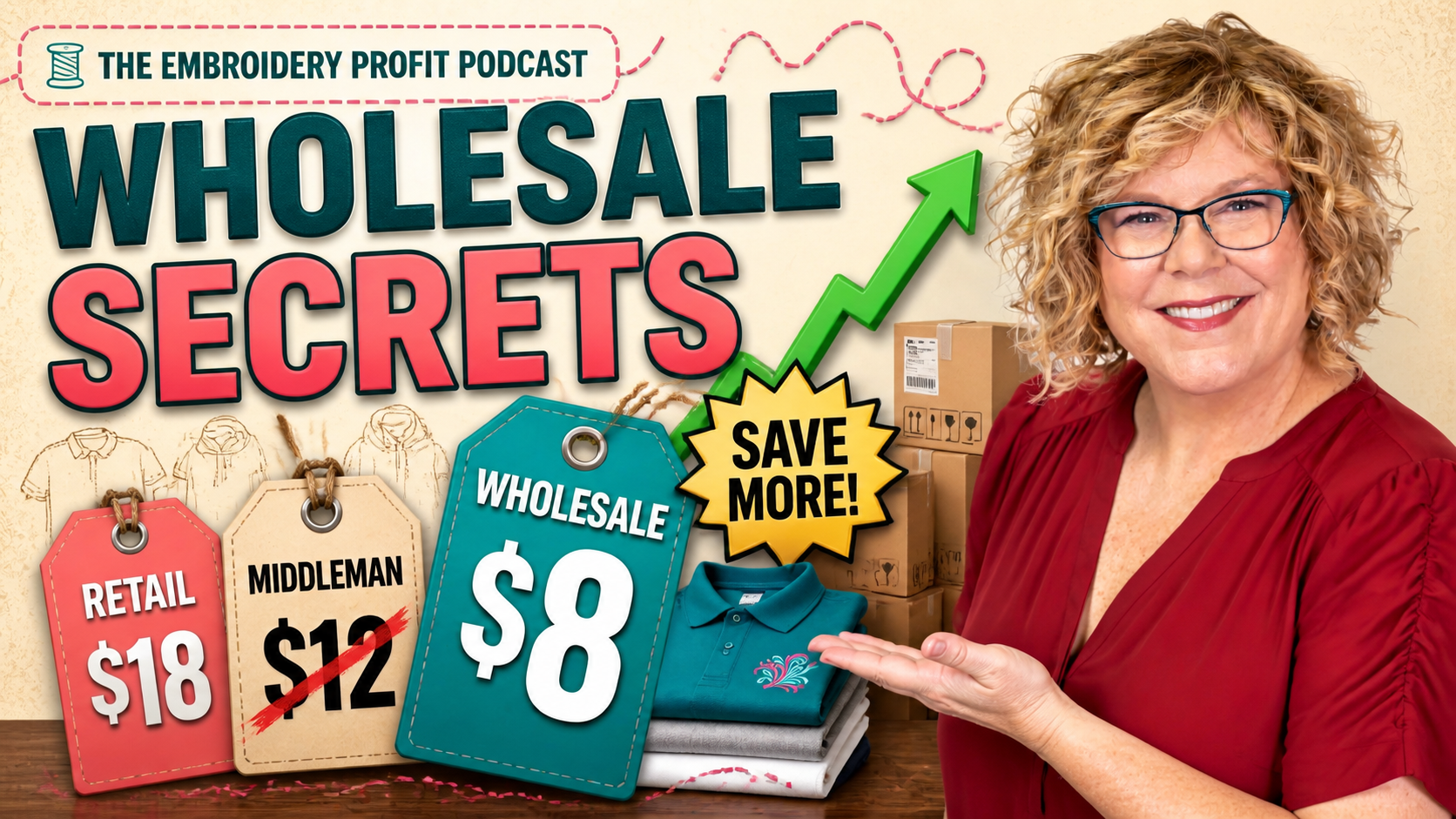
Alpha Broder and Jiffy shirts, I hear a lot of people talking about them, but I want to give you an important distinction. Not all distributors are true wholesale.
So Alpha Broder and Jiffy, they're not true wholesale. You can check out their prices. Sometimes things may be cheaper, but generally they're a middleman.
And so they may order directly from the source and they may charge a little more than maybe Sanmar or SNS. So just do your research and decide where your true wholesale prices are.
Sandmar, SNS, OneStop, those are true wholesalers. So I would encourage you to use them and to register with all of them. But here's something that people don't tell you.
Something that I didn't know and I learned by mistake. Industry secret. And it's pricing tiers.
Industry Secret: The Magic of Pricing Tiers
Most wholesale distributors have a preferred pricing program, which means when you hit a certain spend with them at a certain threshold, then your price drops. All right.
Think about it like going to Costco. You can buy that same toilet paper at Publix, but if you buy it in bulk, you spend more money, your price is lower per roll.
So if you commit to ordering mainly from one source like SANMAR or SNS or whatever it may be, that's a strategic move. Why?
Well, because that stacks your order with one distributor. It consolidates where your money goes and it's going to compound the amount that you spend. And you may just get a phone call like I did.
Let me tell you about what happened to me. Now, this is how I learned by accident. I get a lot of spam calls. I have a landline number because I work out of a brick and mortar warehouse flex space.
Every day one or two spammers call, and usually somebody who can't speak English well. They have a very broken accent and they're trying to sell me digitizing.
Well, this one time I got a call and I'm so happy I wasn't rude to them because it really wasn't a spammer. It was someone from Sandmar.
And she answers the phone, or I answer the phone, and she introduces herself and says that my name popped up as a flag in their system. And she wanted to tell me some good news.
But first, she wanted to know how did I go from the previous year spending $600 to this year spending over $10,000 and it was only June. And my answer was, well, I picked up embroidery machines and a DTF printer.
And they said, well, every so often someone like you pops up in our system. And that means that we're going to give you the very lowest price tier that you can get.
So when you go back in and log into our your account, you're going to find lower pricing. My brain immediately went to woo-hoo. And I asked her, how do I get to the next lowest level of pricing?
And her answer made me so happy, you guys. She said, there is no next level. You've made it. We're happy for you.
Now that was super smart on their part because it's like a rewards program and I didn't even know it. The more money I spent in one place got me to that level faster where they're gonna offer me the lowest price.
Did I pass on that savings to my client? No, I'm not a nonprofit, you guys. I'm in the business to make money. So that just meant a few more dollars in my pocket and my clients still paid the same price that they're used to.
Loyalty to one distributor could pay off literally just like it did for me.
How to Open a Wholesale Account
Now let's talk about how you open a wholesale account. Before you do, you're gonna need a couple things. You're gonna need a registered business name and you're gonna need a state resale license.
And you can't get a resale license until you have a business. So you wanna check with your accountant, your CPA, or whoever helped you get your business started.
You're gonna apply at a state level for your resale license. And why that matters is a resale license is usually what most wholesalers need to start an account.
That way you can go ahead and purchase from them tax-free. And then you're going to charge your client that sales tax. In every transaction, one person needs to pay sales tax.
And you're going to make sure it's your client, not you. And so you're going to need a resale license to open up an account.
Now, at SANMAR and SNS, and most of the places that I've applied for online are pretty straightforward. You need to have a copy of that resale license to upload and answer a few questions and usually they'll get back with you to give you your password and your login information.
Another thing I want you to know is that there's terms. When you apply for an account wholesale, usually they're not going to give you terms like 30 day terms.
You order it, receive it, and pay 30 days later. Most places are not going to do that until you're well established. You're going to be on a credit card or a debit card basis, meaning that you're gonna pay as soon as you order it.
And that brings me to another important point. Sanmar recently changed that if you're using a credit card, maybe you have an American Express that you're getting Sky Miles with or something like that.
If you use a credit card, then they're gonna charge you an additional processing fee. But if you use a debit card, which is what I do, then there's no processing fee.
So you wanna check with each distributor with their policy. Find one that works for you, but just know you're gonna need that resale license.
Managing Shipping Costs and Lead Times
Now let's move on to shipping. Not every distributor offers free shipping. Some don't have that option at all.
Recently I came and opened a new account with OneStop. I love their Enza, E N Z A brand. It's really cool when they've got some great t-shirts and some fanware and sportswear that I wanted to be able to offer my clients.
So I set up an account. I got some really great catalogs that I swoon over. And then I called them to order for the first time.
As I was talking to the sales rep, they told me that they don't really have free shipping. But they did start a new program recently where they could offer free shipping if you ordered over, I believe it was, I don't know, don't quote me, $150.
Or if you didn't meet that dollar amount threshold, then they had a flat shipping fee of something like $16 or $18. And I loved that.
Only to find out I am not in the zone. Like, how could I not be in the zone, you guys? I am one number away from the zone where that program works, which was super disappointing because their warehouse is on the other side of the country.
For that reason, while I love their product, I may not be ordering from them. But let's take Sandmar. Usually with Sandmar, if you order $200 or more, you get free shipping.
And if you happen to have a warehouse close to you, that could mean that you have one day shipping if you order by a certain time. And that's usually the opportunity that I use with the free shipping.
Sometimes I don't have enough orders to meet that. And sometimes I'll throw in a sample to build up my blanks or something for me personally or a family member. But sometimes I just don't want to do that.
I don't need anything. And so then there's another shipping option from Sanmar, and I'm sure with other companies as well, where you pay less shipping and you can get a standard week turnaround.
For me on Sanmar, $200 gives me free shipping, or for a few products, if I want next day delivery, it's usually $29 and some change. That's for the next day. Or it's about $14 or $15 and a week turnaround.
Now, what I do is I use that as an upsell. So if my client is ordering a few things, I let them know hey, I do have a minimum. You can order whatever you want, but my vendor charges me shipping and I'm gonna pass that on to you.
So with this order, you have two options. We can do it fast, which is going to be a $30 add-on fee for vendor shipping, and that's going to get it to me within a couple days.
That means your turnaround time's probably going to be a week. Or we can save you some money and it'll take longer and it'll be $15 shipping, but that's going to be a two to three week turnaround time. What works best for you?
So that's how that conversation goes. Now, some people will charge an up fee for handling on that shipping. It's your business. You're gonna set the policy however you want.
Just think about that now and be consistent. But hey, if you decide you want to change that policy, you're not locked into it. You can change anything at any time, but it's good to start somewhere.
Customer Supplied Garments: Risk vs. Reward
While we're talking about wholesale, let's just talk about what makes a blank embroiderable. Is that a word? Embroiderable? I think it is.
I just made it up, but you get what I mean. So garment weight and construction really make a difference in how you're going to embroider it.
Obviously, the heavier weight the garment, you're gonna have better success with embroidering. So just keep that in mind. A good example is comfort colors is like a cult following.
It's really not one of my favorite, but people go gaga over comfort color t-shirts, but they're very lightweight. Well, they're heavyweight for t-shirts, but they're still considered to be lighter weight.
So you're probably not gonna have good results with a dense embroidery. So that might be better suited for DTF transfers. Now, Comfort Color does have some awesome sweatshirts and cropped shirts, and those work good for embroidery.
The thing I want you to know is knowledge builds over time. The more you embroider, the more you learn. And you can start building your sample base right now, one sample at a time.
Now, a strong recommendation, you've heard me say this again and again. If you're just starting out, you probably don't want to take customer supplied garments early on.
Because if you eat them or your machine eats them, you're gonna have to replace them. Even with a signed waiver that says that you're not going to replace them, you might feel obligated to.
Now, I've been in the industry for 30 years and I do a lot of customer supplied garments. People bring me their Peter Millar shirts, which are $150.
I do a lot of Lululemon. But if something goes wrong, you have to ask yourself, do you have a budget to replace it?
Or better yet, do you have a customer disclaimer form for them to sign to release you from all liability? I have those on my website.
You can find those in the links below. Or you could just make up your own. But it's your business, decide.
Do you want to order the blanks so if something goes wrong, they'll never know it and you can replace it? That's a decision you need to make. And you want to make sure you have peace of mind in what you do.
Summary of Sourcing Success
So the key takeaway from today is you probably don't need inventory, especially if you're gonna work B2B. Special order per job to keep your overhead low and your profits high.
Build your sample slowly, one order at a time, three to five max pieces in each category, and try to use a true wholesale source instead of the middleman.
Get your business name, your resale license, and make sure it's your client who pays sales tax for those and not you. And have your credit card or your debit card ready to pay for those orders up front.
If this episode has helped you buying blanks to stop buying them from Hobby Lobby or wherever your margins are thin, please share this with a friend. I'm Hope Yoder. This is the Embroidery Profit Podcast, and I'll look forward to seeing you next time.
If you want more tips on how to scale your embroidery business, make sure to subscribe to the Embroidery Profit Podcast on your favorite platform!
Episode 19: Contract Embroidery Exposed — with Joe Perez