Episode 20: Nobody Wants to Do This Embroidery Job. But the Bikers Need You To
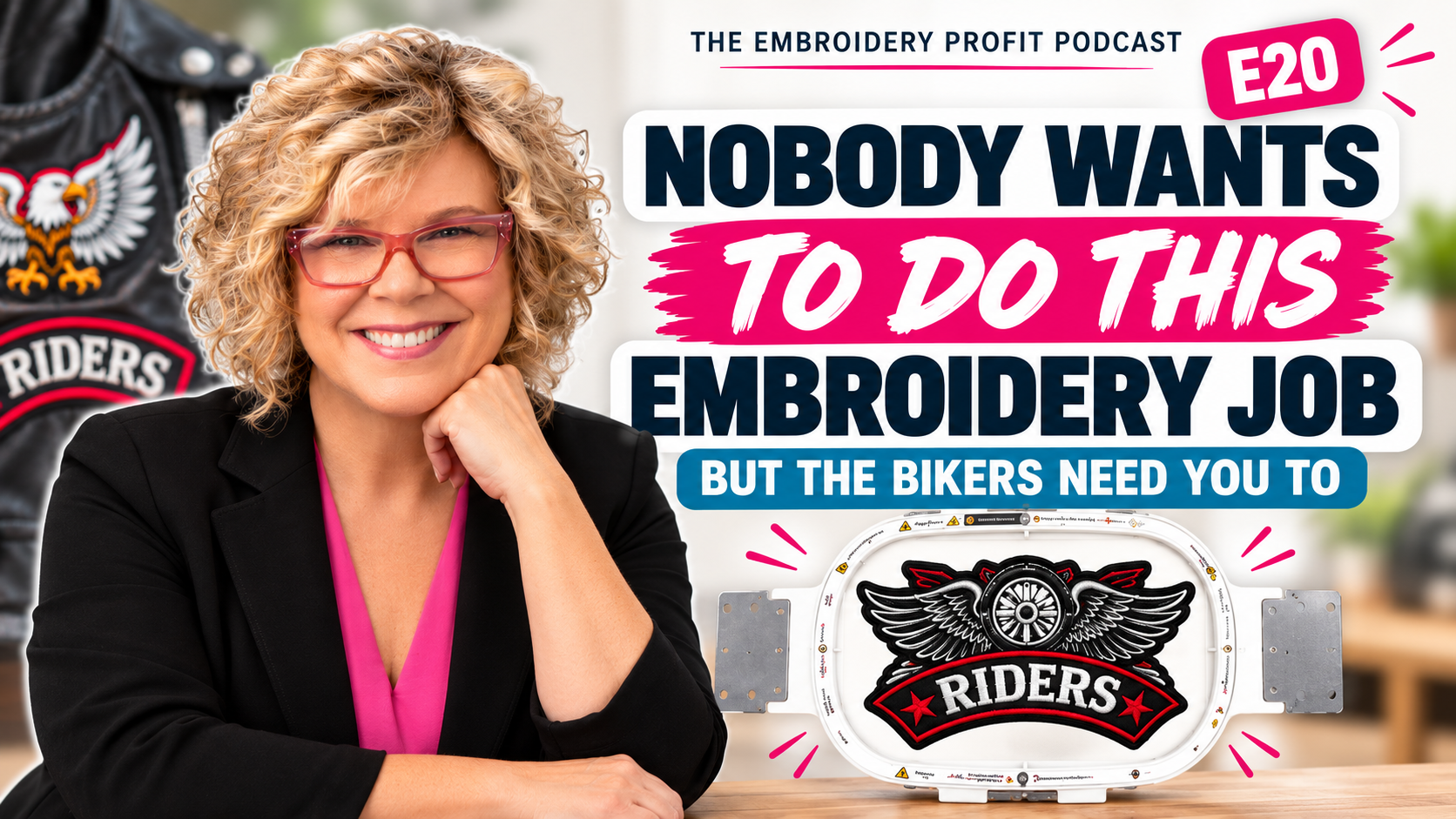
Why Embroidery Shops Say No to Custom Embroidered Patches (And Why You Should Say Yes)
The Job Nobody Wants to Do
There's a whole category of embroidery work that shops won't touch. Not because it's illegal, not because it's hard to sell, but because nobody taught them how to do it. And now they just assume they can't.
So they say no over and over again to paying customers. Two big orders, two repeat businesses. And those customers, they just keep on calling. They keep looking and they just can't find anybody to say yes.
Today I'm gonna tell you what job this is, why shops keep walking away from it, and why I've been saying yes to this for 30 years because there's real money sitting in this niche, and most of your competition doesn't even know it exists. Hi, I'm Hope Yoder, and you're listening to the Embroidery Profit podcast.
Understanding the Blue Ocean Strategy
Let's dive right in today. I want to talk about something called Blue Ocean. Maybe you've read the book called Blue Ocean Strategy. If you haven't, let me tell you about this theory that's in the book.
Well, it's really not a theory, but this book was a little bit hard to read. But man, as I got in, there was some really good analogies, and I want to share the whole simple idea with you.
Most businesses, no matter what business you're in, they compete in a red ocean. Everybody's fighting over the same customers, the same price points, and the same products. It's bloody, it's exhausting.
But a blue ocean, okay, that's open water. That means no competition. You're not fighting anyone because you went somewhere that nobody else went because they didn't want to. Now here's an analogy straight from the book that stopped me cold.
Let's talk about the circus. For decades, the circus was the circus. It was started, well, I don't know if it was started, but Barnum and Bailey and Ringling Brothers. Do you remember as a kid going to a circus?
Everyone was competing for the same thing. They kept getting bigger animals, more animals, more stunts, louder acts, but it was the same red ocean. They were all competing against each other until enters Cirque des Soleil.
They said, what if we got rid of the animals entirely? What if we made it an art form, theater under the big top, music, story, acrobatics? They didn't compete with the existing circus model. They created something entirely new and they became the most profitable entertainment company in the world, you guys.
That's what a blue ocean is. As I'm saying this, I literally have chill bumps because I'm always trying to find a blue ocean for my business.
Finding the Blue Ocean in Embroidery
So what would that mean in the embroidery world? Now I want to remind you that I've been in this industry for 30 years and I've seen things come and go like bell bottoms. Remember when they were hot and then they weren't? And then they were again.
All right, my blue ocean is patches, custom embroidered patches, woven embroidered patches on twill. So I want you to think about satin patch borders or marrow edge patches that are done in the hoop or chenille patches, the kind that you see on biker's vest or varsity jackets or military uniforms.
Why Shops Are Afraid of Patches
Now I'm gonna let you in on a little known secret. Most embroidery shops don't do patches. Why? Because maybe the process feels complicated. There are a lot of steps and patches, and you need the right type of equipment, you need to know the stabilizers.
You basically need a roadmap and you need to have the right type of digitizing. And if nobody has ever shown you the right way, it feels easier just to say no. And I really think that's why a lot of shops say no to patches.
And so that means that they're not serving their customers and their customers are going to go somewhere else. Like to me, someone who does make patches.
A True Story of Outsourcing Competition
I want to tell you a true story about my business. I got a call from an embroidery shop owner from another state. She followed me in a laser group and she had a client who wanted patches.
Now, what's crazy is she did the same type of things that I do: left chest polos, jackets. And when she called me, she told me who she was and that she owned an embroidery shop. And she didn't want to make patches. She tried it, they didn't turn out well.
And she kept following me on socials and said that my patches looked amazing. So she called me a competitor and asked me if I would make patches for her so that she could send them to her client as a white label item, meaning she would say that she made them.
Or maybe she wouldn't say that, but she wouldn't tell her that she subbed them out to someone like me. Now, I want you guys to think about that for a second. She was willing to outsource to a shop me in a completely different state, pay me for my work, and have me send the patches to her so she could use them as her own because she didn't want to take the time to figure out how to make patches because they didn't turn out great in the past.
This just shows you how badly shops want to avoid making patches. But it also should show you, like it showed me, that there's a demand for this. If someone who does the same thing is willing to pay someone else to do it, that could be a niche that you want to go into.
The Massive Demand in the Biker and Rider Niche
People often call me the patch queen. And as I was training my embroidery coworker to make patches with the steps using my exact framework, she said to me later, "These are so cool. I love making this. Have you ever thought about making biker patches for motorcycle clubs?" And I thought, no, I have never thought of this. Why haven't I thought of this?
And as we went on to a conversation, it turns out that my co-worker up north was part of a biker club. Well, not really a biker club, a rider club. Apparently, there's a real difference. And I'm pretty girly girly. I don't ride a motorcycle. I don't really know anybody that does. So this is not in my world, but it's in her world.
But as we started talking, she said, why don't I just call the local motorcycle shop and do some snoop shopping for you and find out if they have anybody to make patches? So we found two local bike shops that are well known.
She called them on the clock using her own cell phone number and she got some great information. The first one said, you know, we can't find anyone to make custom embroidered patches well. So we stopped offering them. But we do laser engraving patches.
Hmm, let's think about this. They couldn't find anyone local to make them. And most of your customers, they don't want to go to that big patch factory that makes them online because they know they probably outsource them to another country. They really want American made, and a lot of people are willing to pay for this.
So that first call really opened my eyes and made me think, man, I'm probably leaving money on the table. Now, my coworker went on to tell me that she was in a riders's club and they had patches made and they were in the same dilemma up north.
They couldn't find anyone local to make them well. Or really in the United States, it was hard to find what she wanted. Now they didn't want generic patches. They wanted their own logo made on it, really big for the back.
And what she ended up doing is outsourcing them to another country. And several years ago they paid a couple hundred dollars per patch. Now the really cool thing about this story is they made the same patch for everyone in the club. So that meant it made my job easier. If I got in this niche, I wouldn't be making a one-off, I would make several of these.
Now she called another shop and they said the same thing. Nope, we don't make them, can't find anybody to do them well. So what if I was a person to do them well? What if I came up with a cool patch design that would represent what we could do?
And I had it digitized and I stitched it out, and I walked into those shops with some business cards, dressed nice and said, "Hey, I wanna just introduce you to our shop. We're local to your area. And this is what we can make for your clients. We'd love to build a relationship where we can refer people your way while you refer them ours."
Does that have your mind racing right now? Hey guys, we'll be right back to the show, but I want to ask you a question. Do you know how to make patches? Have you ever wanted to learn how to make patches?
For me and my business, they're huge. They open up the door for bigger orders. And I wanted to tell you about an online course that I have called Patch It Perfect. In this course, you're gonna get 30 Done For You designs, and I'm gonna teach you everything you need to know on how to make freestanding patches, woven patches.
There's even a bonus section with a hat bar. I'm gonna leave the link in the show notes below, or you can go to hopeyoder.com, look under the online courses tab. Let's get right back to the show.
Exploring High-Level Equipment and Chenille
Now, recently, about a week ago, I was contracted to teach at an embroidery conference in Miami. And when I was there, I was still thinking about this conversation in my head with my coworker.
And I walked by a machine running that was on display in the vendor area. It was a Chenille machine. Now I'm a Chenille. Chenille, Chenille, tomato, tomato. So this machine had two embroidery heads, one that did traditional embroidery and one that did the needle punch Chenille.
So if you don't know what Chenille is, it's loopy, it's that fuzzy stitch that you might see on old letterman jackets. The patches that look like they came off a high school varsity jacket from 1975.
That machine could run both types of embroidery, chenille and regular embroidery at the same time. And you guys, I'm not gonna lie, I kept going back again and again to that machine. I had to stop the drool.
I even filmed it and put it in my embroidery lounge Facebook group. And I got to thinking, now I know that might take a long time to stitch out those patches, but I saw money in that machine, right? If I wanted to go into the writer's world and make some really cool patches, you know, Chanel would be a significant upcharge.
I haven't bought it yet, but I still have that in the back of the mind. I might need to Dave Ramsay it. If you don't know what I mean, go back to the last episode or a former episode titled Dave Ramsey.
And I bet you I have money sitting around my shop or my home that I could use to fund that new piece of equipment that would help me really step up my game and go high level. Speaking of patches, if this episode has made you think, I want to tell you that I have an online course called Patch It Perfect.
It has 10 lessons and 31 done for you files where you can learn to go high level and step up your patches, whether it's a satin edge border or a marrow edge border. The transformation I hear from my students going through this course is they go from not being able to make consistently good looking patches to making three times what the course cost in their very first order.
If you're ready to go high level and make custom embroidered patches, check out my Patch It Perfect course. The link is in the description below. All right, let's get back to the episode.
Conclusion: Stop Saying No to Profit
So I have a question for you guys. What is your blue ocean? Here's the thing: for you, maybe it's not patches like it is for me. Maybe your blue ocean is baby items or team uniforms or a sport that nobody covers in your area.
It could be a corporate gift set that includes embroidery and laser engraving together. The point of this episode is not patches. The point is where is the job in your market that nobody else is willing to do?
What are customers calling you about because they can't find anybody else to do it? Because whatever it is, there's an unmet demand that you may have skills to do it. It may be your blue ocean, or you may find a course like my Patch It Perfect course that'll help you go high level and that could become your blue ocean.
Most shops are swimming in the red water, fighting over polos and shirts and left chest logos. I'm not saying don't do that work because I do. I'm saying don't only do that work. Find the thing your competition won't touch.
Learn to do it better than anyone. And be the only yes and a sea of no's. I'm going to talk in my next episode about a coaching session that I did inside of my one-to-one Embroidery Profit Academy. And we're going to dive deeper into this.
But if this embroidery episode got your wheels turning, share this episode with someone who embroiders. Someone who might keep saying no to the things that they just don't know how to do yet. Because maybe the most expensive word in your business isn't a machine or a material. Maybe it's the word no.
I'm Hope Yoder. This is the Embroidery Prophet Podcast. Go find your blue ocean. And when you do, send me a message. Let me know what it is. And if you've loved the Embroidery Prophet podcast, do me a favor. If you're watching on Apple Podcasts, leave me a five-star review and help me get the word out about all the training that I give you absolutely free. See you on the next episode.
Episode 19: Contract Embroidery Exposed — with Joe Perez